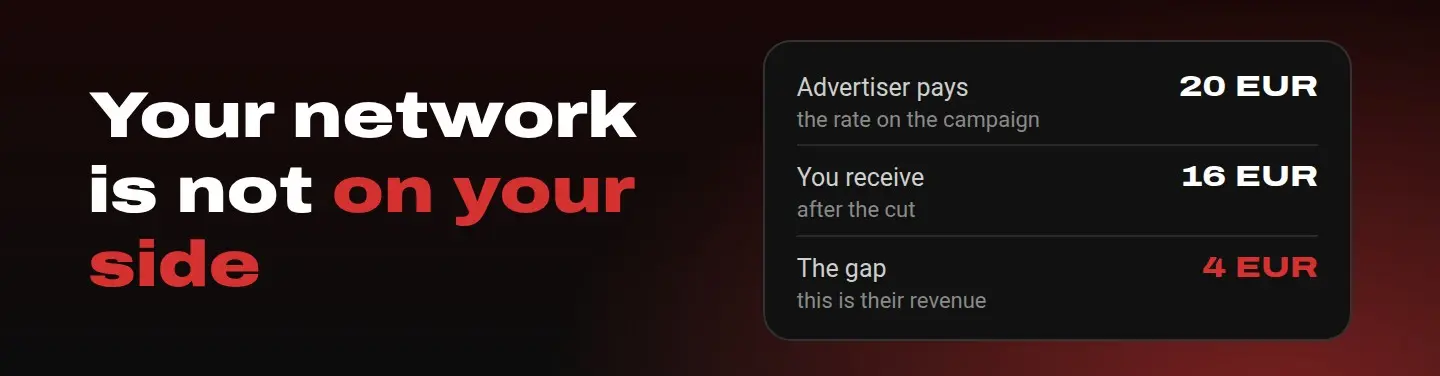
Your network is not your enemy. But it is not on your side either, and the reason is structural rather than moral.
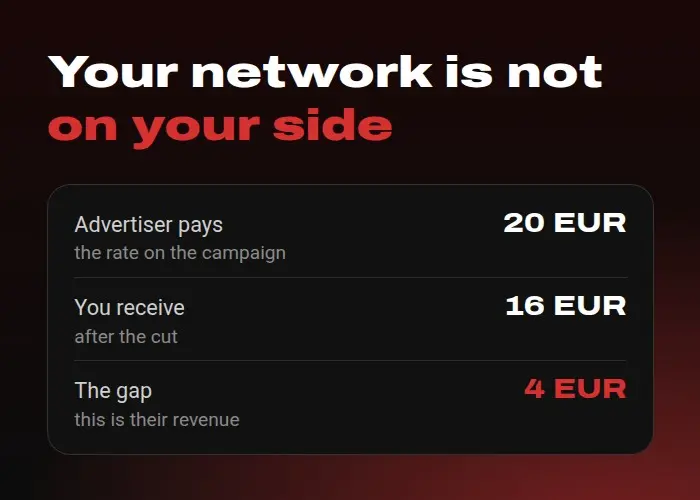
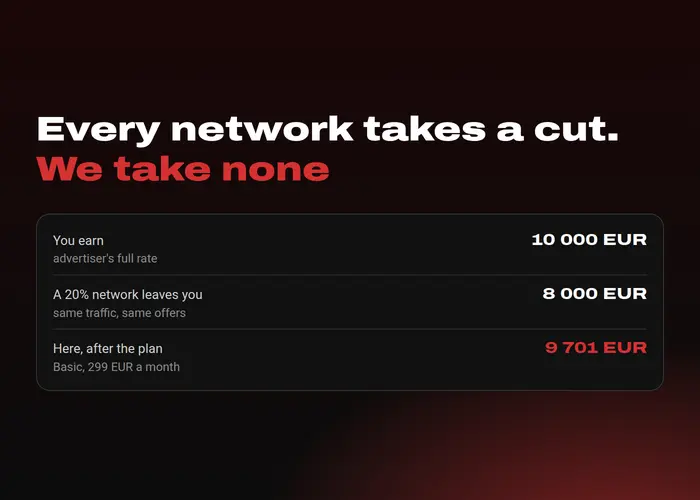
In a percentage model, the network's revenue is the gap between what the advertiser pays and what you receive. That is not a side effect of the business. It is the business. Once you see it that way, a lot of things that look like bad service start looking like rational behaviour instead.
Everything else in this article follows from that middle box.
The gap makes information expensive
If your revenue is the difference between two numbers, you have an interest in one of them staying invisible.
That is why asking what the advertiser actually pays is such an awkward question. Nothing shameful is being hidden. The answer simply states the size of the margin out loud, and no business volunteers that. The standard response is a version of "that is commercially sensitive", which is true and useless at the same time.
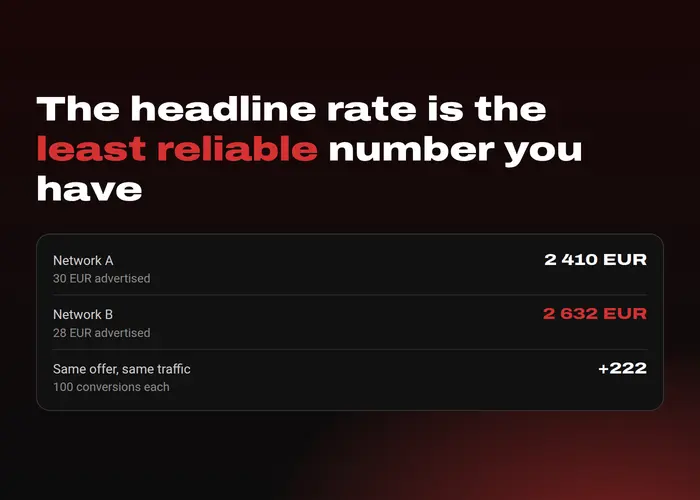
So you optimise against a number you cannot see. You know your payout. You do not know what fraction of the total it represents, and you cannot tell whether a network quoting two euros more is being generous or just taking less.
The gap puts a price on your approval rate
In a percentage model, your approval rate and the network's revenue sit on the same line.
A conversion rejected after the advertiser has paid for it does not vanish. The money arrived. It just did not reach you.
Most networks do not touch this, and the ones that do tend not to last. But the incentive is real, it is invisible from your dashboard, and the only way to detect it is a controlled comparison across two platforms running identical traffic. That is a month of work almost nobody does, which is precisely why the incentive survives.
What you can see
Your payout rate. Your approval rate. Your conversions.
What you cannot see
What the advertiser pays. Why a conversion was rejected. Whether the rate passed through another network before it reached you.
The second column is where the margin lives.
The gap turns your money into working capital
Net-30 is standard. It is also a month of your revenue sitting on someone else's balance sheet.
Networks do pay you before the advertiser pays them, and that float costs money. Fine. But the length of the delay is a commercial decision, not a technical constraint, and it is set by the party that benefits from it being longer.
Nobody shortens payment terms by accident.
We built it the other way
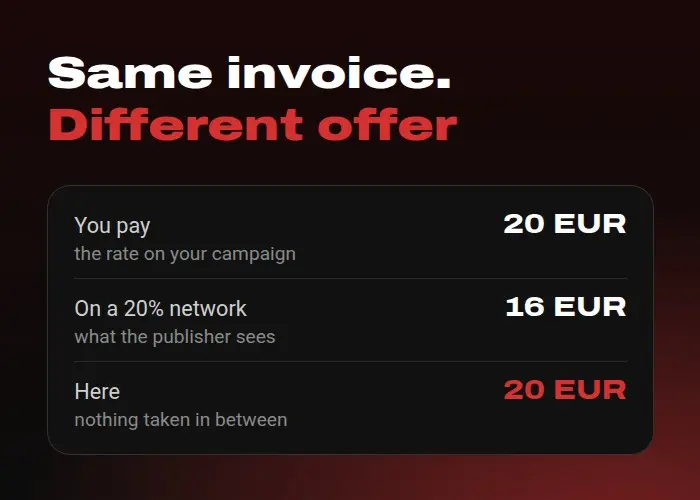
AffMarket charges a flat monthly fee and takes 0% of conversions. The rate the advertiser sets is the rate that reaches you.
This does not make us nicer. It removes the gap, and with it every incentive above.
| Percentage model | Subscription model | |
|---|---|---|
| Revenue | The gap between two numbers | A fixed monthly fee |
| Rate visibility | Works against the network | Nothing to hide in the rate |
| Rejections | Have a revenue side | Cost us nothing either way |
| Payment delay | Is a benefit | No float to finance |
We have no reason to keep the advertiser rate from you, because our revenue does not depend on the difference. We gain nothing from a rejected conversion, because we were never taking a share of it. Holding your money longer earns us nothing, because there is no float to finance. There is also no minimum payout and no payout fee, so nothing is taken on the way out either.
The incentives we do have
Pretending a subscription has no incentives would be its own kind of dishonesty. It has two.
The first points your way. We need you to renew next month, and that only happens if the platform earns you more than it costs. A percentage network makes money whether you grow or stall, as long as you convert something. We do not. If your campaigns stop working, we lose a customer.
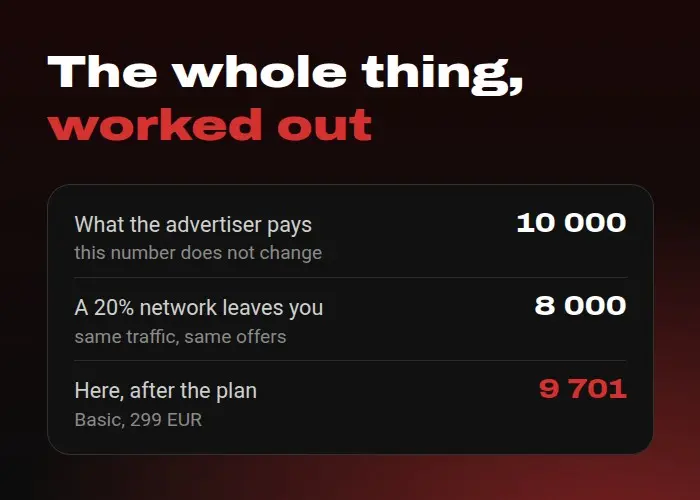
The second points the other way, and it is the one to watch. The fee is the same whether you clear the breakeven or not, so the model only makes sense above a certain volume. That is why we publish the line and repeat it everywhere: Starter pays for itself from around 330 EUR a month in commissions if your network takes 30%, closer to 500 EUR if it takes 20%. Below that a percentage network is the better choice, and we say so rather than let someone find out after paying.
Check it yourself
None of this requires taking our word for it, and you should not.
Take one offer running on several platforms and compare the quoted rates. A platform sitting consistently below the others with no explanation is telling you something about the chain that rate travelled through before it reached you.
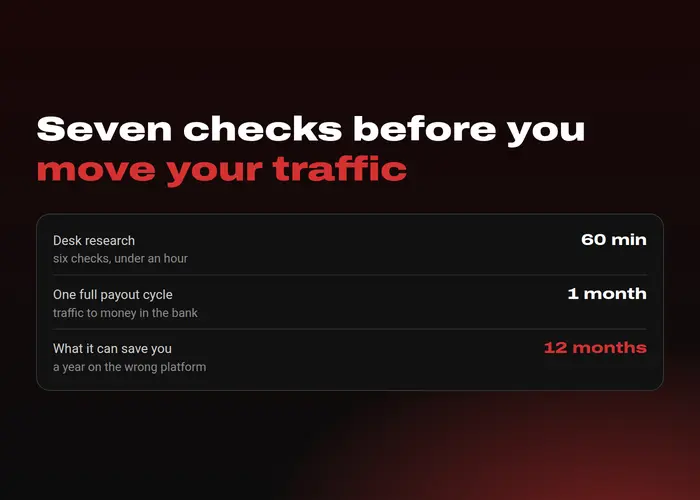
Then run the harder test. Same advertiser, same product, your traffic split evenly between two networks, held long enough for both validation windows to close. If approval rates differ substantially on identical traffic, you have something concrete instead of a suspicion.
It takes a month. It is also the only way to find out, and the gaps it exposes are usually large enough to change where your traffic should be going.
The short version
Nobody in this industry is behaving strangely. Networks respond to the incentives their model creates, and in a percentage model those incentives point away from you on rate transparency, approval rates and payment timing.
We did not fix that by being more ethical. We fixed it by taking the gap out of the business, which leaves nothing for us to optimise at your expense.
The rate you see is the rate you get
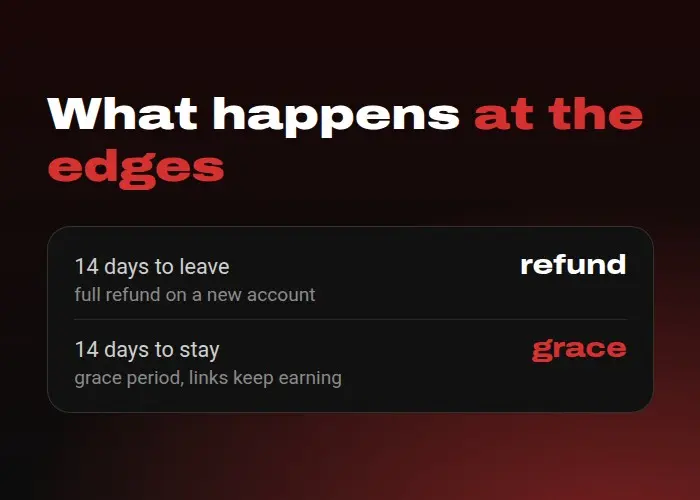
0% commission on your conversions, no minimum payout and no payout fees. Fourteen days with a full refund, so you can check it against your own numbers.
See the plans →