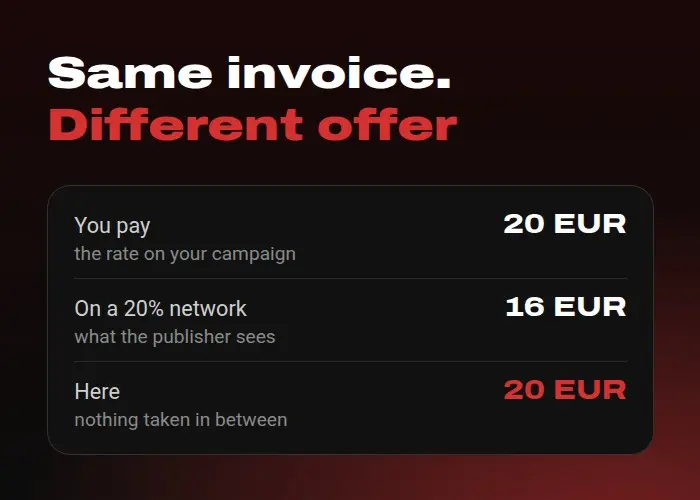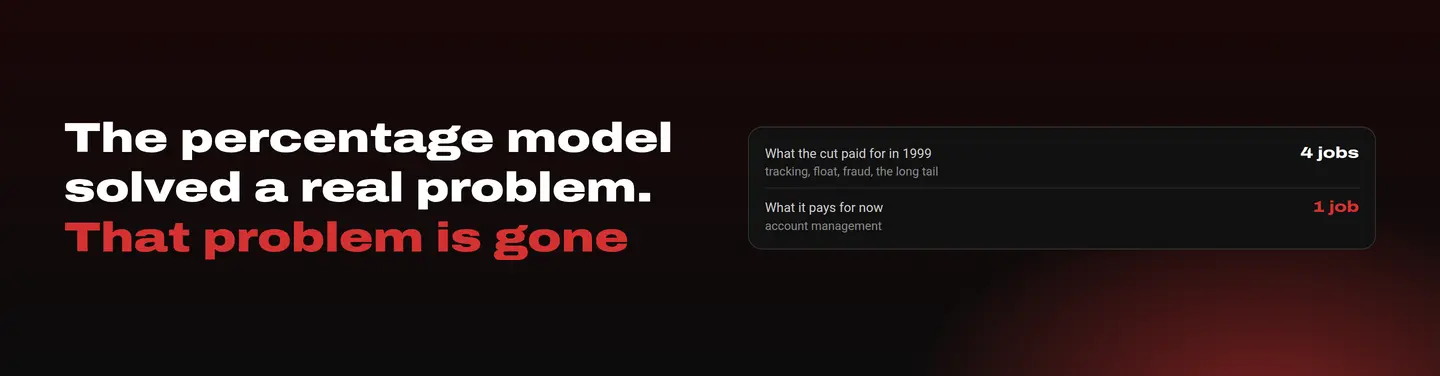
Every affiliate network charges a percentage. Not most of them. All of them, for roughly thirty years, across every vertical and every market. When an entire industry converges on one pricing model and stays there, it is usually because that model solved something.
So before arguing that it should change, it is worth being precise about what it solved, and whether those problems still exist.
What the cut was actually paying for
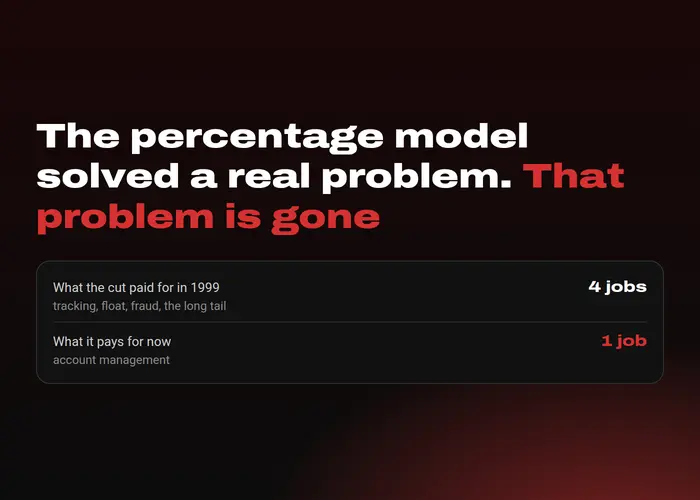
In the late nineties, when affiliate networks took their current shape, a network's commission covered four distinct jobs. Not one.
01 Somebody had to build the tracking
Attribution was the hard problem. Linking a click on one site to a purchase on another, reliably enough that an advertiser would pay for it, required infrastructure that no individual publisher could build and no advertiser wanted to maintain. The network built it once and rented it to everyone.
02 Somebody had to carry the money
Advertisers paid on net-60 or worse. Publishers needed paying sooner than that, and some advertisers did not pay at all. The network sat in the middle, financed the gap and absorbed the bad debt. That is a real service with a real cost, and a percentage of revenue is a sensible way to price a risk that scales with revenue.
03 Somebody had to filter the fraud
Open signup, no verification, thousands of accounts, and a payout model that rewards volume. Policing that was expensive and never finished.
04 Somebody had to serve the long tail
The publisher base was enormous and mostly tiny. Hobby sites, personal blogs, people earning twenty dollars a month. Charging that population a fixed fee would have emptied the network overnight. A percentage costs nothing when you earn nothing, which is exactly what made the model work at that scale.
Four jobs, one price. For that market, at that time, it was a good answer.
What changed
Three of those four jobs have since been solved by other means, and the fourth describes a publisher base that no longer looks the way it did.
And the publisher base professionalised. The long tail did not disappear, but the revenue stopped sitting there. A large share of volume now comes from a comparatively small number of operators who run paid media at scale, hold their own advertiser relationships, and already pay flat fees for every other tool in their stack.
That last point is the one that matters. Trackers charge a subscription. Spy tools charge a subscription. Hosting, cloaking, creative tools, data providers, all subscriptions. The network is the only line in a media buyer's cost sheet that scales with their success rather than with their usage.
The asymmetry nobody removed
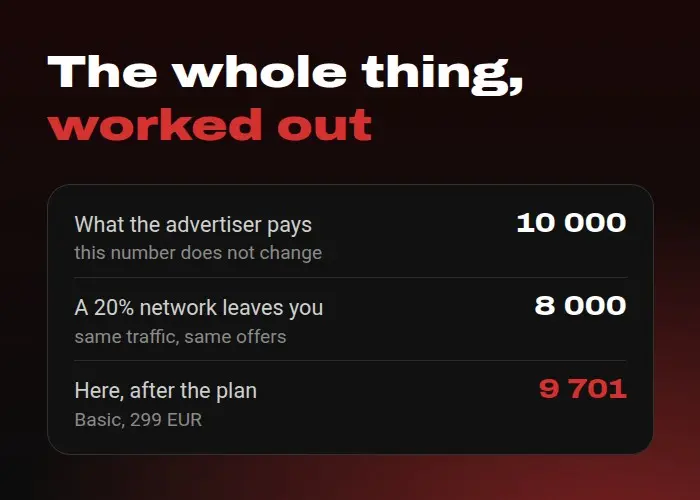
Here is the arithmetic that has quietly got worse every year.
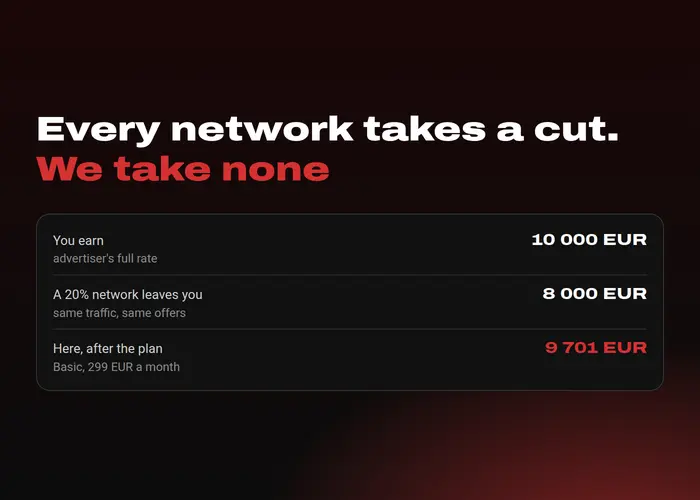
| Publisher earns | Network keeps at 20% | Cost to serve that publisher |
|---|---|---|
| 2 000 EUR | 400 EUR | Roughly the same |
| 10 000 EUR | 2 000 EUR | Roughly the same |
| 50 000 EUR | 10 000 EUR | Roughly the same |
A publisher doing 50,000 EUR a month does not consume twenty-five times the support of one doing 2,000. They usually consume less, because they ask fewer basic questions and break fewer things.
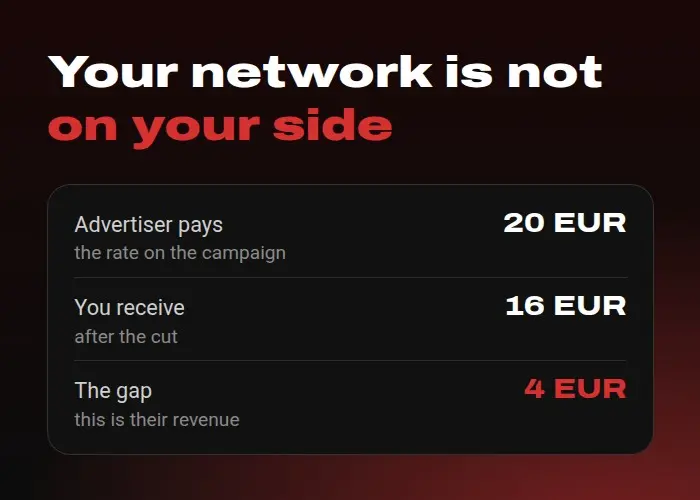
The price scales with the publisher's success. The cost scales with almost nothing.
In 1999 that gap was narrow, because the network was genuinely doing four expensive jobs. Today it is wide, and most of what the percentage buys has been unbundled and sold separately to the same publisher, who is paying for it twice.
So why has nobody changed it
Two reasons, and neither is stupidity.
01 The incumbents cannot
An established network switching to subscriptions would have to replace commission revenue with subscription revenue on day one, from a publisher base that mostly sits below the point where a subscription makes sense. Most accounts on a large network earn very little. Charge them a monthly fee and they leave. Keep them free and the model does not fund itself.
That is not a decision anyone makes voluntarily with a working business attached to the old model. It is the classic position of an incumbent who can see the change and cannot survive making it.
02 The window only opened recently
A subscription network needs a publisher base where enough operators clear the breakeven. That population is much larger now than it was ten years ago, and it did not exist at a workable size when most of today's networks were being built.
It also needs tracking, payments and verification to be cheap enough that a flat fee covers them. That became true gradually, and gradually is hard to notice.
What we think we are doing
We are not claiming to have had an idea nobody else had. Subscription pricing in affiliate marketing has been discussed on forums for years. The difference is that we have no commission revenue to protect, which makes it a straightforward decision rather than an impossible one.
That is the whole advantage, and it is a temporary one. Any network that launches after us can do the same thing.
Where this could be wrong
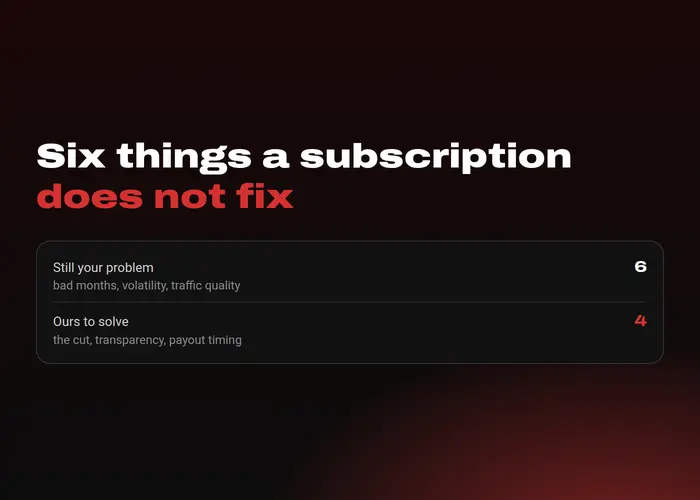
The percentage model has one genuine virtue that a subscription does not: it is robust to bad months. A publisher who earns nothing pays nothing, and a network built that way keeps accounts that a subscription model would lose.
That matters more than it sounds. Affiliate income is volatile. Traffic sources die, accounts get banned, verticals go quiet. A model that charges regardless is harder to live with than one that charges only when you win.
What the percentage model still does better
Costs you nothing in a dead month. Carries the risk of volatility on the network's side. Works for publishers at any volume, including very small ones.
What a subscription does better
Stops taking more as you grow. Removes the incentive to keep the advertiser's rate hidden. Makes platform cost predictable before the month starts.
Which of those matters more depends entirely on where you are. Below the breakeven, the first column wins and we say so on our own pricing page. Above it, and especially well above it, the second column wins by a margin that grows every month.
The short version
The percentage model was not a mistake. It was the correct answer to a set of problems that have mostly been solved since, by tools the publisher now buys separately.
What is left is a price that tracks your success and a cost that does not. Somebody was going to charge for the service instead of the outcome eventually. It was never going to be a network with commission revenue to defend.
Pay for the platform, not a share of your work
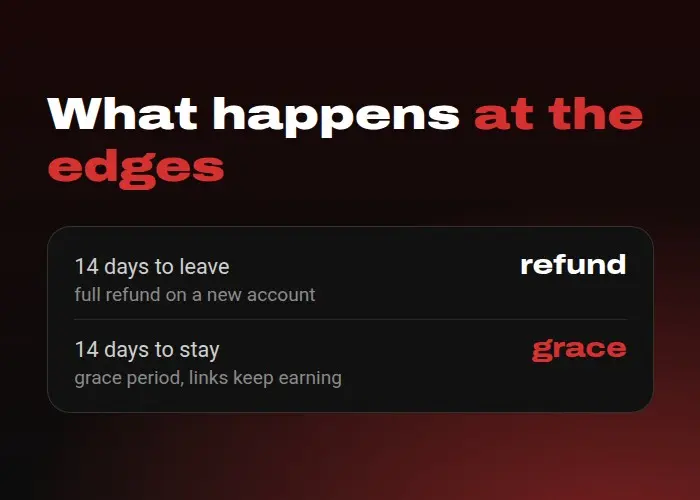
0% commission on your conversions, a flat monthly fee instead. Fourteen days with a full refund, so you can check the arithmetic against your own numbers.
See the plans →