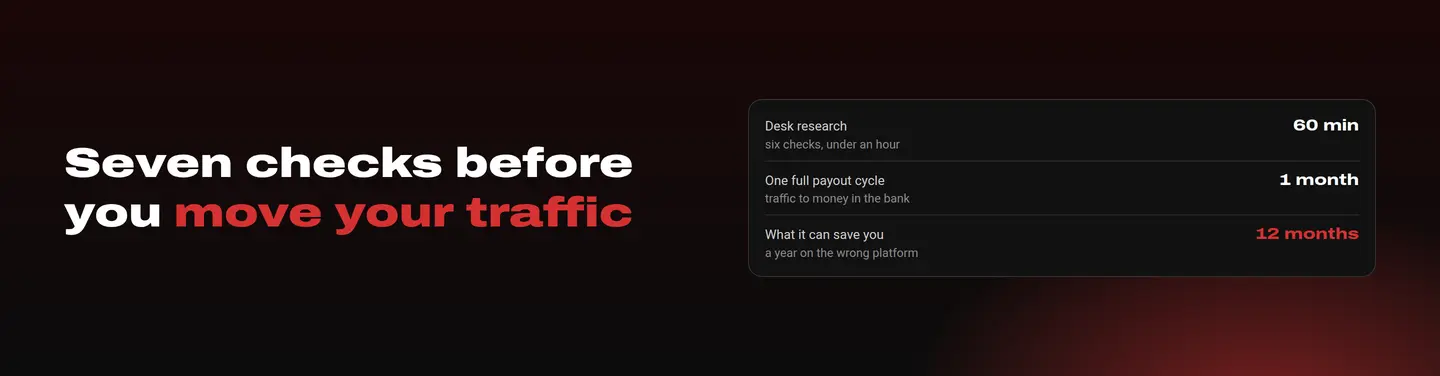
A new network launches, promises better rates and faster payments, and asks you to move your traffic. Sometimes it works out. Sometimes the payments slow down in month three and the manager stops answering.
There is no way to know in advance with certainty. But there is a set of checks that separates a platform worth testing from one worth avoiding, and most of them take under an hour.
We are writing this as a network that went live on 18 November 2026, which means we fail some of these checks ourselves right now. More on that at the end.
01 Payment proofs
The first thing experienced publishers look for, and rightly so. A directory listing with verified payout screenshots from real publishers tells you money has actually moved.
But read them properly. A payment proof from six months ago says nothing about whether the network is paying today. Check the dates, check whether proofs are still appearing recently, and check whether they come from different publishers or the same two accounts repeatedly.
The absence of proofs means one of two things: the platform is too new to have them, or it has been running long enough to have them and does not. The second is the problem. The first is just a fact about timing, and it puts the burden on everything else in this list.
02 Who is behind it
Not the brand story. The actual people.
Look for names, histories and traceable work. A team that has run networks or bought traffic at scale leaves a trail: conference talks, forum accounts with years of posts, previous companies. A platform that will not say who runs it, or whose fifteen years of experience attaches to no individual you can look up, is asking you to trust a claim rather than a record.
This matters more for a new platform than an established one. With no payment history to judge, the people are most of what you have.
03 The payment terms, in writing
Before you send a click, you should be able to answer these without asking anyone.
| # | The site should answer this before you sign up |
|---|---|
| 01 | What is the payment schedule |
| 02 | What is the minimum payout threshold |
| 03 | How long is the validation window before a conversion is confirmed |
| 04 | Under what conditions can a confirmed conversion be reversed |
| 05 | What happens to earned balance if your account is closed or suspended |
| 06 | Who pays the transfer fees |
If any of these requires a conversation with a manager rather than a page on the site, that is information worth noting. Terms that exist only in a chat window can change without anyone telling you.
Question five is the one people skip and regret. Find out what happens to money you have earned but not withdrawn if something goes wrong with the account.
04 Whether the rates are actually direct
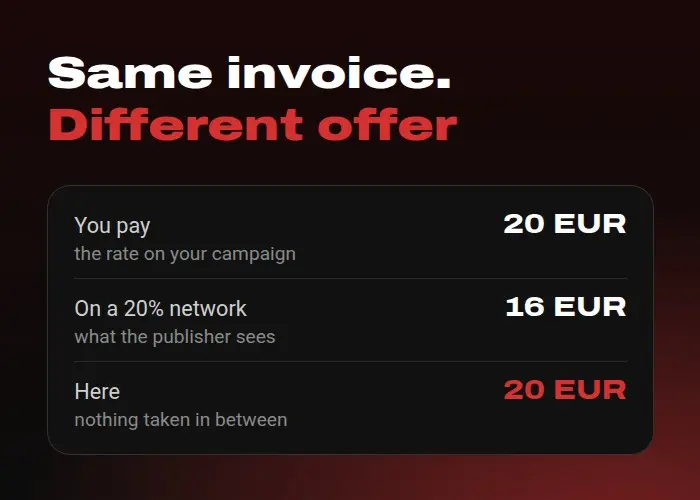
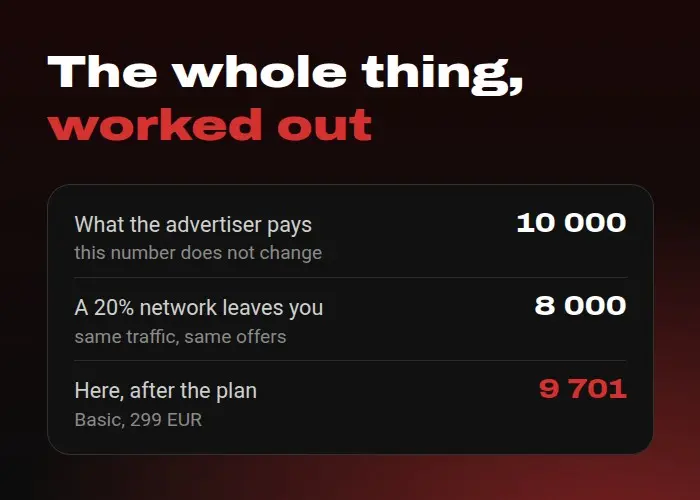
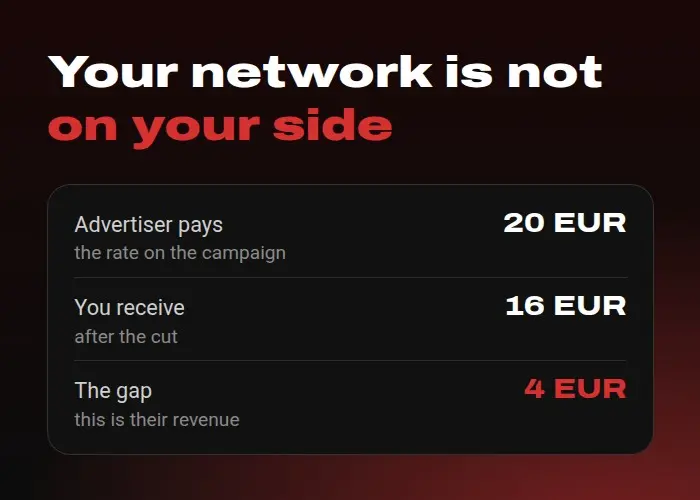
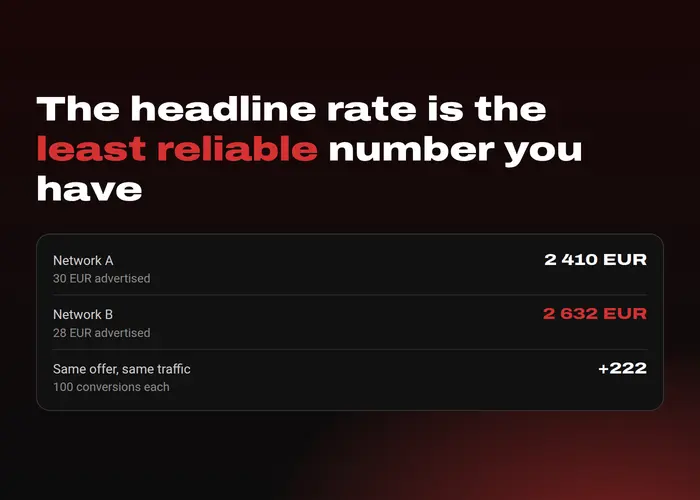
Take an offer that runs on several platforms and compare the payouts. If one sits consistently below the others with no explanation, the rate probably passed through a chain before it reached you.
That is not automatically disqualifying. Plenty of successful networks aggregate other networks' offers and publishers stay with them because the access and the tooling are worth it. But you should know which one you are dealing with, because it tells you where the ceiling on your rates is.
Ask directly whether a given advertiser relationship is direct. A platform that answers plainly is more useful than one that keeps it vague.
05 How they talk about their own limits
This is the softest signal and, in our experience, one of the more reliable ones.
A platform that tells you who it does not suit, which verticals it does not cover, and what it cannot do yet is making claims you can check. A platform where every answer is positive is either very new or not being straight with you.
Watch what happens when someone asks a hard question in public. Does the answer engage with it, or restate the pitch in different words?
The question
"What happens to my balance if my account gets suspended?"
Not an answer
"We pride ourselves on transparency and strong publisher relationships."
06 The exit
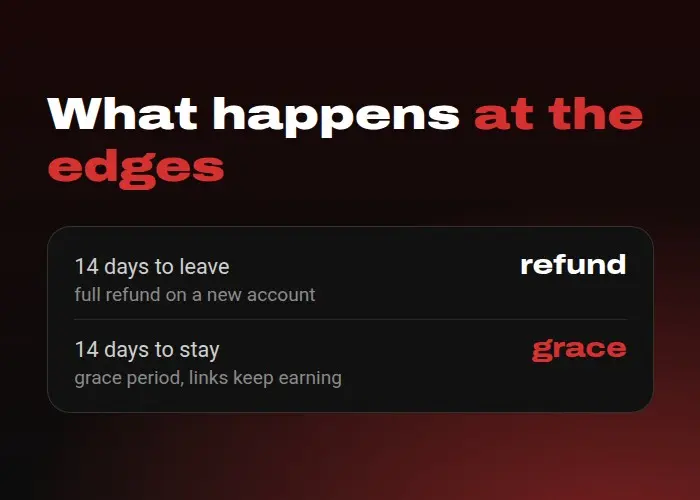
Before you commit, work out how you leave. Is there a refund window. Can you withdraw a partial balance. Is there a contract term or notice period. How quickly can you move your traffic back if the first month does not work.
A platform that has thought about how you leave has usually thought about why you would stay.
07 Test small, with real traffic
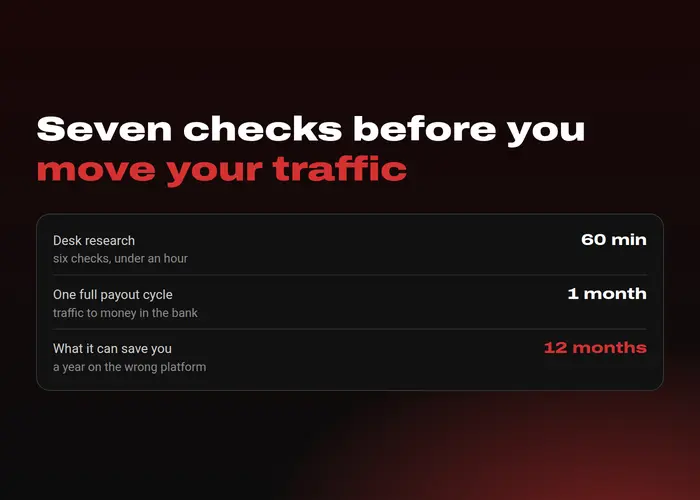
Everything above is desk research. None of it substitutes for sending traffic.
Run one offer, enough volume to reach the payout threshold, and take it all the way through to money in your account. Not to the dashboard showing a confirmed conversion. To the bank.
One full cycle, end to end
Only the last step counts. Check whether the approval rate matched what you were told, whether payment arrived on the stated schedule, and whether anything was deducted that you did not expect.
That one cycle tells you more than every other item on this list combined.
Where we stand on our own list
We said at the top that we fail some of these. Here is which ones.
We have no payment proofs. We launched this week, so there is no payment history to show yet. The first proofs will exist after the first cycle and not before.
We have no publisher track record under this brand either. The team is not new, but you have to take the team's history on its own terms rather than on this platform's results.
On the rest we are in reasonable shape. Payment terms, validation, the refund window and what happens to your balance if a payment fails are all written down on the site rather than left to a manager. We have said publicly which verticals we do not cover at launch and why, and which publishers the model does not suit.
Check us against your own list
Pricing, terms and monthly payout limits are all on the site before you sign up. Fourteen days with a full refund, so the exit exists before you need it.
See the terms →