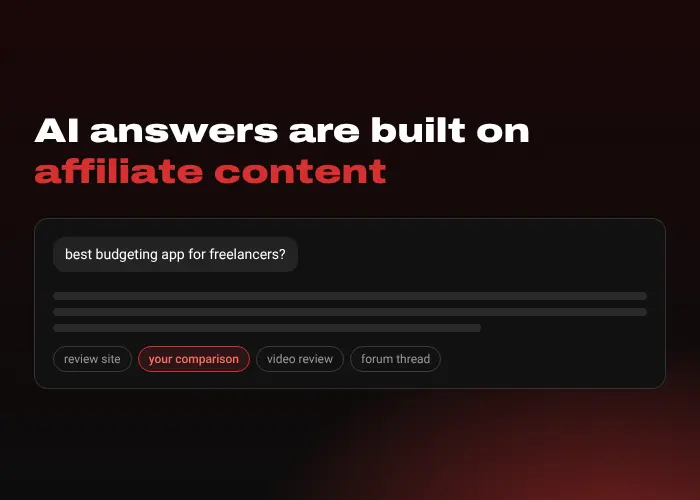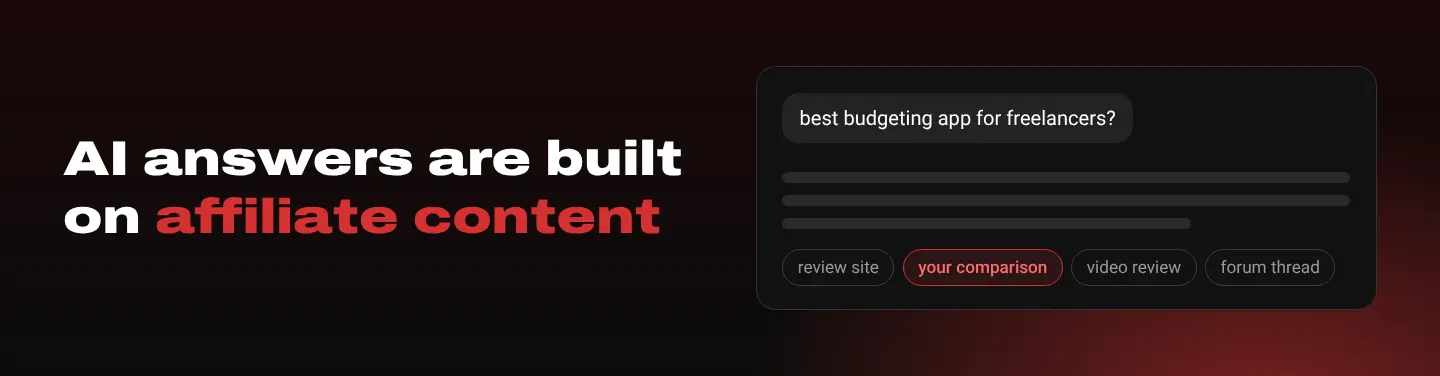
Do one thing before you keep reading. Open ChatGPT, type something like “best VPN for streaming”, and ignore the answer. Scroll to the sources underneath.
What do you see? Roundups. A couple of “this vs that” pages. Probably a YouTube review. Anyone who’s run offers for more than a month spots the pattern straight away. It’s right there in the URLs.
Affiliate links. The models are quoting affiliates. Depending on how you feel about it, that’s either flattering or a bit absurd. We’d call it good news with a catch. The catch is traffic (it shows up later), and so is the practical stuff you can do on Monday.
In this piece you’ll see
- Who gets quoted - three studies and how much we’d trust each
- What kind of page gets picked - and why coupon pages finish last
- Two worries you can drop - affiliate links and mentioning competitors
- Why being quoted doesn’t mean getting the visit - and what that does to the value of a lead
- Six things to do about it - none of them needs a budget
Who gets quoted
First the numbers, because “AI loves affiliates” is the sort of line people repeat at conferences without checking. Three companies looked. None of them did it thinking about publishers (their readers are brand managers and in-house SEO people), so treat the table as someone sitting on the other end of those programs.
| Study | What was checked | Result |
|---|---|---|
| AirOpsOct 2025 | 21,311 brand mentions in answers from ChatGPT, Claude and Perplexity | 85% of mentions came from external domains, 13.2% from the brand’s own site. Nearly 90% of the third-party mentions sat in listicles, comparisons or reviews. |
| EvertuneDec 2025 | The 10,000 sources AI models cite most often | More than 40% of that content contains affiliate links or is sponsored. |
| SemrushNov 2026 | 2,850 pieces its affiliate partners published about Semrush, checked against tracked AI answers from 14 Sept to 7 Oct 2026 | About 22% were cited in at least one answer. |
Different firms, different samples, same basic story. An assistant asked “what should I buy” doesn’t go to the brand’s own site. It goes to whoever wrote about the brand. And a lot of the time that person is earning a commission.
How much weight can these numbers carry? Some. Evertune’s 40% comes from one sentence its CEO said in a press release, and we haven’t seen the method. Semrush studied its own program for three and a half weeks in a niche where the affiliates are, let’s face it, mostly SEO people. So yes to “this is where things are heading”, no to plugging any of it into a spreadsheet.
What kind of page gets picked
The bit of the Semrush data we like most is the split by content type, mainly because of who came last.
Share of partner pieces cited in AI answers, by format
Source: Semrush, 2,850 partner pieces, Sept to Oct 2026.
54% of listicles got cited at least once. Coupon and free-trial pages? 10%. If you’ve ever wondered whether the assistant “reads” your page, here’s the practical answer. It needs something to say. Someone types “which one should I get”, the model has to come back with reasons, and reasons live in comparisons. What does a promo code give it? A price. That’s it.
One side note. Most of those citations came from Google, not from ChatGPT. AI Overviews cited roughly 8% of the pieces, AI Mode 7%, Gemini 2%, and ChatGPT a whole 1%. One program, small sample, but still a useful reminder of where the volume sits.
Two worries that turn out to be nothing
“AI will skip my page because of the affiliate links.”
Nope. Semrush went through 302 cited pages and 74% had affiliate links. Roughly 40% had those links tagged sponsored or nofollow. Videos were even less shy about it, 89% with a link, 88% with a disclosure.
Does that mean links help? No, and Semrush doesn’t claim that either. They just don’t get in the way. So stop hiding them. Put rel="sponsored" on the link because Google asks for it. Add a disclosure a normal human would notice, because the FTC asks for that. Done.
“Mentioning competitors sends my readers elsewhere.”
Some of them, sure. Now look at this. Three out of four cited pages named at least one competing product. 60% named two or more. And the pages nobody cited? 42%.
Correlation, we know. But you’ve seen both kinds of page. One says product A is wonderful, here’s the button. The other puts four products next to each other and tells you A is fine for beginners, B is cheaper but support takes two days to answer, C only makes sense for agencies. Which one would you quote if you were the assistant?
Now the bad news
Getting quoted is not the same as getting the visit. Here the data is ugly.
Pew Research Center tracked 900 adults in the US during March 2025, close to 69,000 Google searches in total. With an AI summary on the page, people clicked a regular result in 8% of visits. Without one, 15%. The links inside the summary itself, the ones everybody is fighting to be in, got clicked in 1%.
Old data? A bit. It’s from 2025 and it’s Google only. We’d be surprised if a 2026 rerun looked any friendlier.
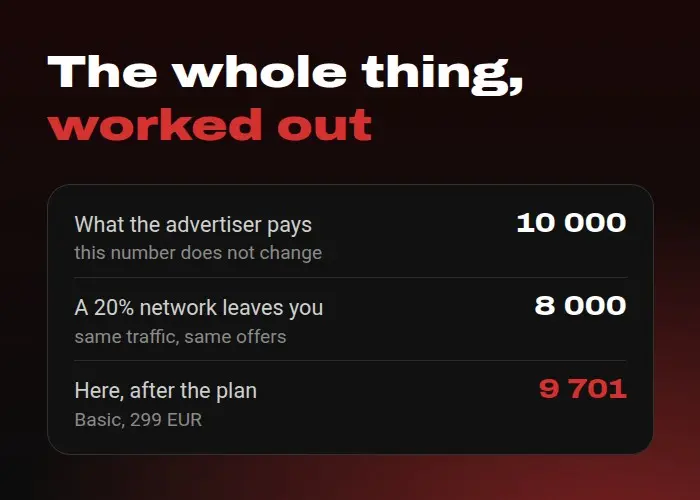
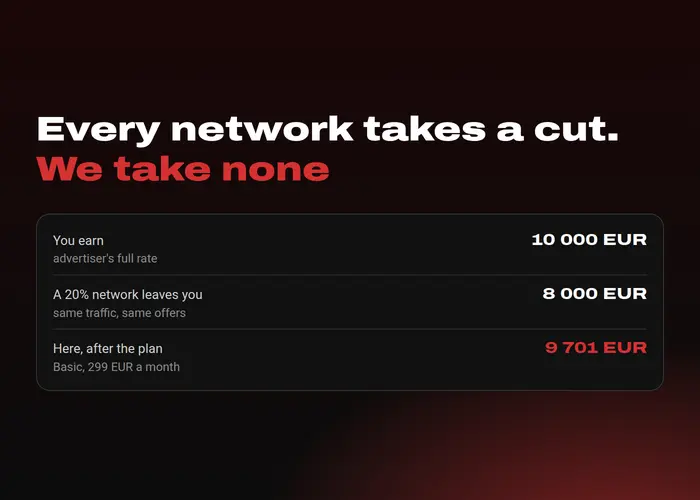
What do you do with that? You won’t get those clicks back, and we’re not going to pretend there’s a trick. What’s left is squeezing more out of each visitor who still shows up. The bluntest way to do that has nothing to do with content. Say you send 100 leads to an offer that pays $40.
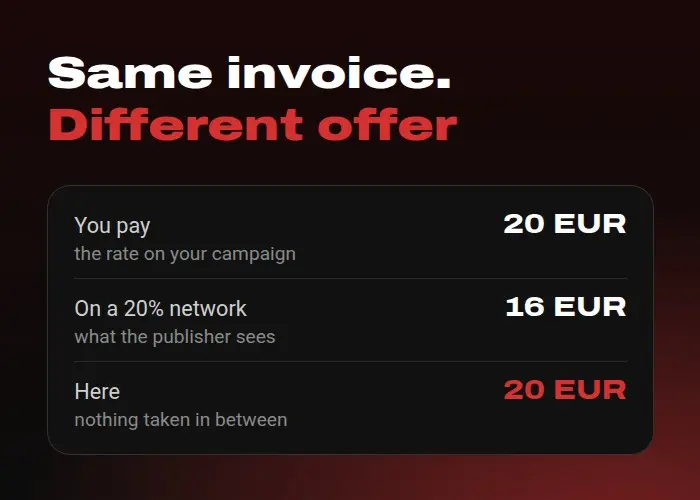
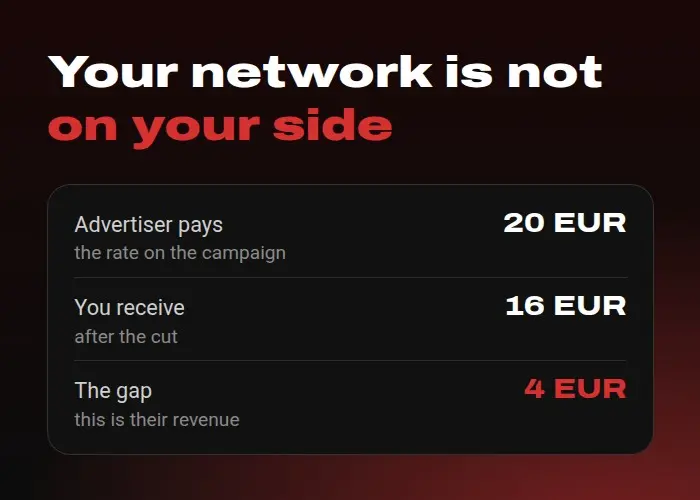
Nothing changed between those two boxes except who keeps the 30%. That’s $1,200 on a hundred leads.
The second box is us. AffMarket passes on the advertiser’s full rate and lives off a flat subscription.
The plans and what each one includes are on the pricing page, and how it works walks you from sign-up to your first payout.
Six things to do about it
Media buyers, a word. If paid traffic is all you run, your campaigns look the same tomorrow as they did yesterday. Come back to this list the day you own a content page worth protecting.
1Write down what your buyer types into the chat
Questions, not keywords. “Best budgeting app for freelancers.” “X or Y for a team of five.” “Is Z worth it or is it a scam.” Get to ten, stop at twenty. That’s your keyword research now, like it or not.
2See who gets quoted today
Paste every question into ChatGPT, AI Mode, Perplexity and Gemini and dump the sources into a sheet. Run each one two or three times, because the answers move around. An hour, maybe less. You’ll come out with a list of pages you’re competing against, and don’t be shocked if it has little in common with Google’s top 10.
3Write the page that should be there
Go for the question with the weakest sources. You’ll know them when you see them. Last updated in 2023, 600 words, written by somebody who clearly never logged into the product. Then beat it. Say what you compared and how. Add a table. Who should take which option, and which one you’d take yourself. Then the things nobody else has, like your own test, a dashboard screenshot, real payout numbers, the day you checked. And yes, include the options that pay you nothing. Painful, but leave them out and you’ve written a sales page.
4Go back to it
Last year’s comparison loses to this year’s, even a worse one. Put “last updated” where people see it and reopen your top pages every few months. Old prices kill conversion anyway, so it’s not extra work, it’s work you were skipping.
5Record a video
Of everything Semrush found cited, almost half was video (283 clips next to 302 pages). Nobody’s asking for a studio. Share your screen, click through two offers, say what you think. That’s a second ticket to the same answer.
6Keep score
Same questions, once a month, write down where you appear. There are paid tools for it (Semrush has one, Ahrefs has one), but start with a spreadsheet. Per page, two numbers, what it earned and how often it got cited. Some pages print money and never get quoted. Some get quoted everywhere and earn nothing. You want to know which is which before you write the next one.
So, good news or bad?
Both, sorry. The assistants can’t answer a buying question without comparisons and reviews, and a big chunk of those come from affiliates. Coupon sites aren’t going anywhere, they’re just not in the answer. An honest comparison with your own numbers in it can be, tracking links included.
The clicks, though, are shrinking and nobody’s bringing them back. Which leaves two jobs. Be the page that gets quoted. Get the whole payout when somebody clicks.
Keep the full rate on every lead
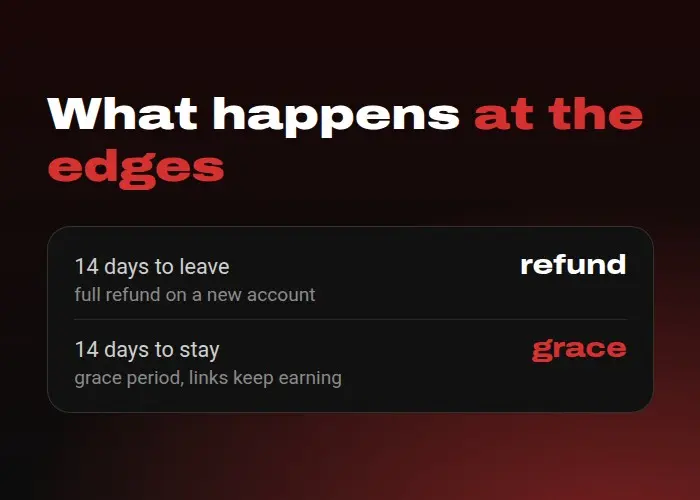
AffMarket is an affiliate network that takes 0% of your payout. The advertiser’s rate is your rate, and we charge a flat subscription. Changed your mind? You have 14 days to ask for a full refund.
Start earningSources
- Semrush, Affiliate marketing is the gateway to AI visibility, 3 November 2026. https://www.semrush.com/blog/affiliate-marketing-ai-visibility/
- AirOps, The Influence of Offsite Signals in AI Search, October 2025. https://airops.com/report/the-influence-of-offsite-signals-in-ai-search
- impact.com and Evertune, partnership press release, 16 December 2025. https://impact.com/press-releases/impact-com-evertune-partnership-ai-search/
- Pew Research Center, Google users are less likely to click on links when an AI summary appears in the results, 22 July 2025. https://www.pewresearch.org/short-reads/2025/07/22/google-users-are-less-likely-to-click-on-links-when-an-ai-summary-appears-in-the-results/
- Google Search Central, Qualify your outbound links to Google. https://developers.google.com/search/docs/crawling-indexing/qualify-outbound-links
- FTC, Endorsement Guides, What People Are Asking. https://www.ftc.gov/business-guidance/resources/ftcs-endorsement-guides-what-people-are-asking