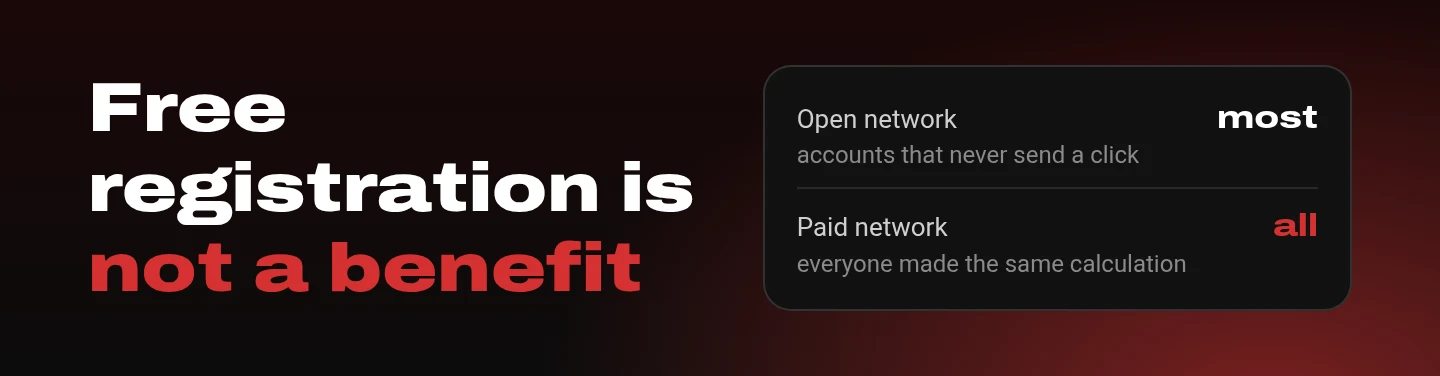
Free registration sounds like a benefit. For publishers running real volume it is usually the opposite, and the reason is arithmetic rather than attitude.
What a free signup actually costs you
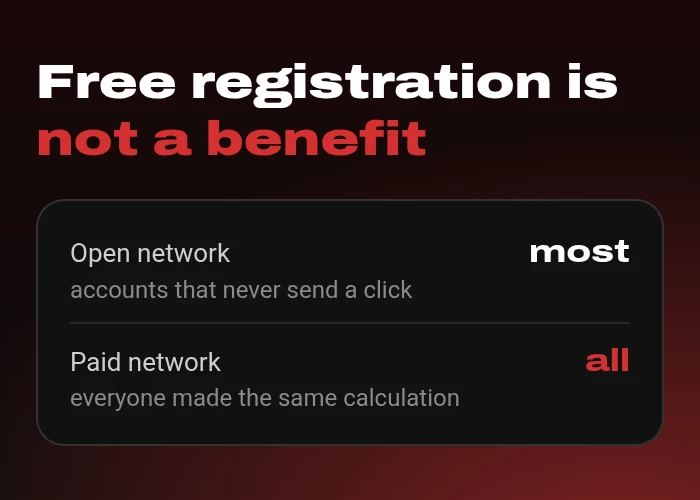
A large network has tens of thousands of registered accounts. A small fraction of them send traffic in any given month. The rest registered once, looked around and never came back.
Every one of those accounts had to be reviewed, approved and onboarded. Each one that asked a question got an answer. That work is real and it is paid for out of the same budget that funds the support you receive.
So the affiliate manager assigned to you also handles several hundred accounts that will never generate a conversion. When you send a question about a payout discrepancy, it joins a queue containing someone asking what CPA stands for. Both get answered in order of arrival, because there is no mechanism to distinguish between them until someone reads both.
This is not a failure of the people doing the work. It is what happens when access costs nothing and support capacity is finite.
Where the money comes from
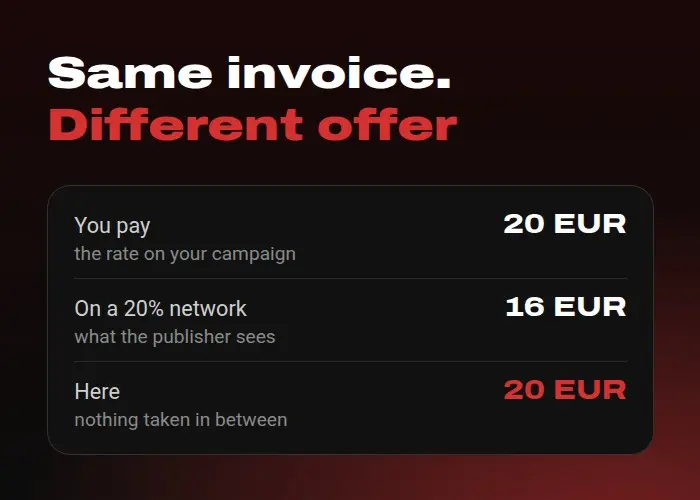
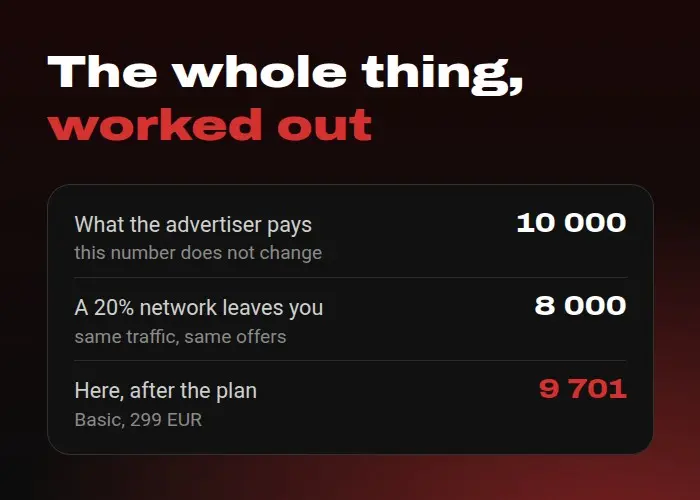
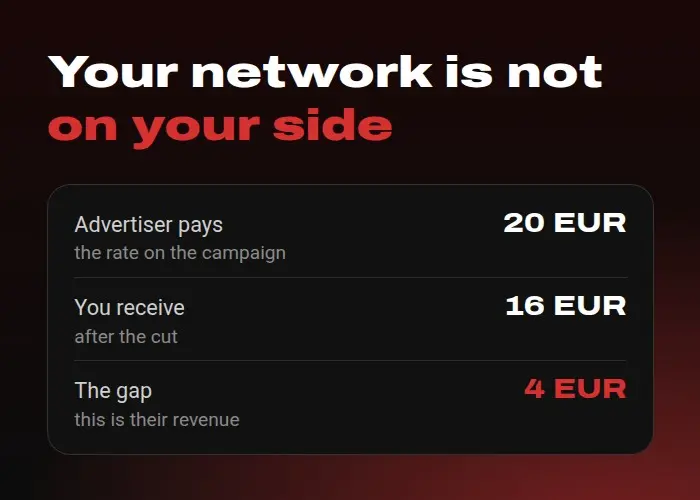
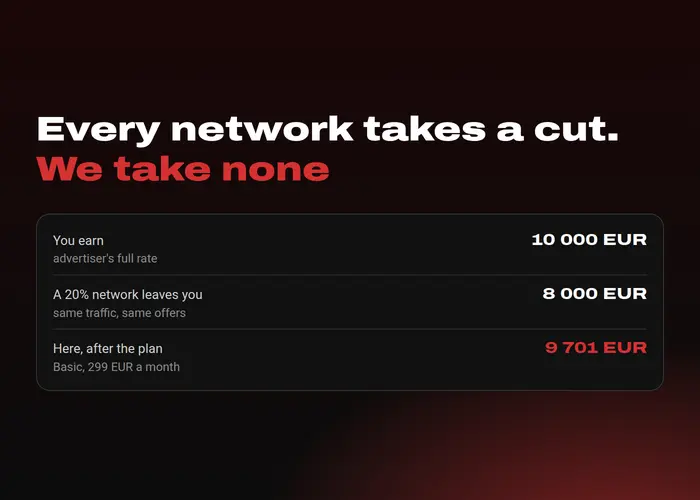
Under a percentage model, a network's revenue comes from a cut of publisher commissions. More publishers means more conversions means more revenue, so the incentive is to register as many accounts as possible and let volume sort out which ones matter.
That incentive produces exactly what you would expect. Aggressive recruitment, low barriers, and a support function sized for an average account rather than a serious one.
Under a subscription, the incentive inverts. Revenue comes from publishers who find the platform worth paying for month after month. An account that registers and churns in week three is a loss, not a lottery ticket.
Percentage model
Revenue scales with account count. The incentive is to recruit broadly. Churn costs nothing, because an inactive account costs almost nothing to carry.
Subscription model
Revenue scales with retention. The incentive is to keep publishers paying. Churn is a direct loss, every month it happens.
That is a harder business to run. It is also one where your renewal depends on whether anyone actually helped you.
The filter is the feature
A subscription does something a free signup cannot. It removes everyone for whom the platform was never going to work.
Bot farms do not pay monthly fees to run fraud. Someone experimenting with affiliate marketing for a week does not either. Neither does an account registered to scrape offer data. All of them are filtered at the door, without a review process, a manual approval queue or an anti-fraud team spending hours on accounts that produce nothing.
What remains is a group of publishers who all made the same calculation: that the platform was worth paying for because they were already earning enough to justify it.
That concentration is the point. Support, account management and negotiation time all go to people running traffic, because there is nobody else in the system.
What advertisers see
This matters beyond support, and it is the part publishers usually care about most.
Advertisers do not judge a network by its registered account count. They judge it by the quality of traffic it sends: approval rates, fraud rates, whether leads convert downstream.
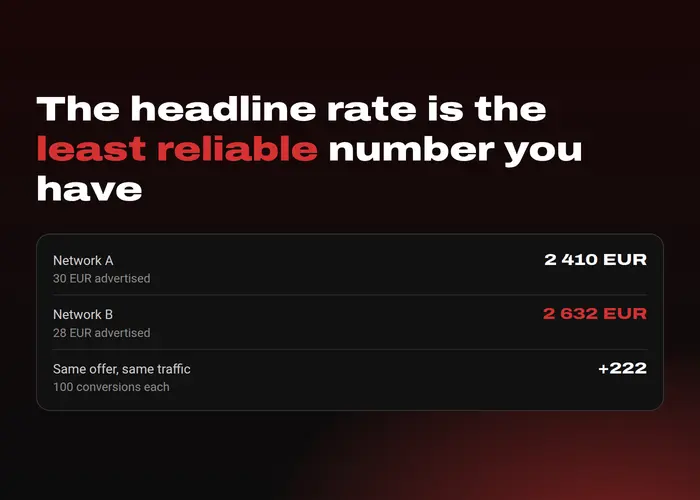
A network where anyone can register sends mixed traffic by definition. Some of it is excellent. Some of it is junk, and the advertiser cannot tell which publisher it came from until the damage is in their numbers. Their response is to price for the average.
The averaging is what costs you. Good publishers on an open network subsidise the bad ones through lower rates, and there is no mechanism for the advertiser to stop doing that.
The honest counterargument
A smaller network has fewer publishers, which means less aggregate volume, which means less leverage with advertisers on day one. That is a real trade-off and anyone telling you otherwise is selling something.
A large network with 40,000 accounts has negotiating weight that a focused platform does not, at least initially. The bet is that quality compounds faster than quantity: that advertisers who see consistently clean traffic will offer better terms than they offer to a larger network sending mixed quality, and that this happens quickly enough to matter.
That bet can be wrong. It is also testable, which is more than most positioning claims manage. Run the same offer on both and compare approval rates.
What this looks like in practice
Concretely, on our side: every plan from Basic upward includes a dedicated account manager rather than a ticket queue. Not because we are generous, but because the subscription model means we can afford to assign one and cannot afford not to.
Scheduled calls rather than asynchronous back-and-forth. Someone whose job includes negotiating campaign terms on your behalf, which is only possible when they are not also onboarding four hundred accounts that will never send a click.
The usual version
Dedicated manager, once you hit 25k a month.
Here
Dedicated manager, because there is nobody else in the queue.
None of that is remarkable as a feature list. Plenty of networks offer dedicated managers to their top publishers. The difference is that it is the default rather than a reward for hitting a volume threshold, and that is a function of how the money works rather than how generous anyone is feeling.
The uncomfortable version
Here is the version that does not flatter us.
A subscription is a barrier we put up and then describe as a benefit. You should be suspicious of that, and the honest framing is that it is both: it filters out traffic nobody wants, and it is also how we get paid.
Whether the filter actually works is measurable: whether publishers who join find the support materially better than what they had, and whether advertisers offer terms that reflect the traffic quality. We launched on 18 November, so nobody has measured it yet. Ask again in six months and there will be an answer rather than a theory.
A manager who is not onboarding four hundred accounts
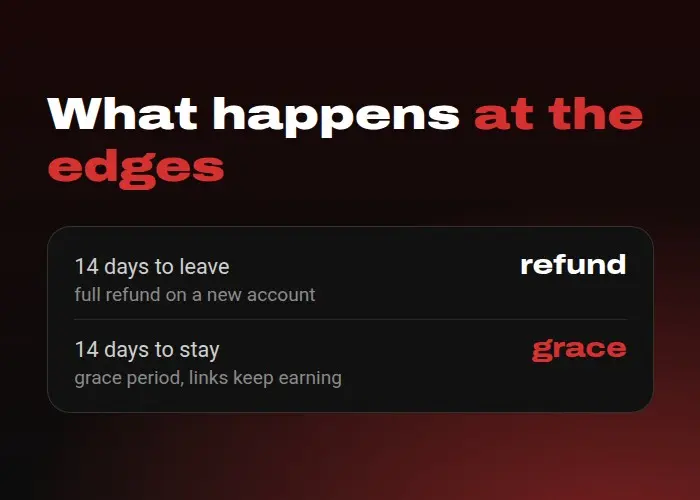
Dedicated account manager from Basic upward, not as a reward for volume. 0% commission on your conversions, and fourteen days with a full refund.
See the plans →